



GMA News - 2026/4
The Ente Nacional de Comunicaciones (ENACOM) released Resolution No. 57/2026 on February 26, 2026. The regulation updates the certification and registration framework for telecommunications equipment and officially revokes the existing Resolution No. 729/1980 on September 1, 2026.

 Algeria
Algeria ARPCE Released Executive Decree No. 26-97
The Autorité de Régulation de la Poste et des Communications Électroniques (ARPCE) released Executive Decree No. 26-97 in Official Gazette No. 13 on February 15, 2026. The new regulation introduces a comprehensive revision of the type approval procedures for electronic communication equipment. The aim is to enhance transparency in the reviewing process, digitalize administrative procedures, and shorten processing timelines. The main points are as follows:
- The certificate validity has been extended from 3 to 5 years.
- Certificates already issued shall remain valid until their original expiration date.
- A digital electronic application platform has been introduced to facilitate and streamline the submission process.
- Samples must be received within 5 working days after the application is submitted. Otherwise, the application will be rejected.
- Lists of approved equipment will be published on the official websites of ANF or ARPCE after certification is granted.
- Mandatory labeling requirements
- The label shall be affixed directly to the device.
- If it cannot be labeled on the device itself, it shall be placed in the user manual or on the outer packaging.
- Label format: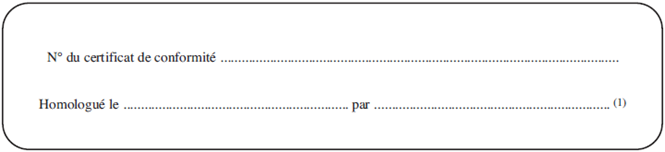
 Argentina
Argentina ENACOM Releases Resolution 57/2026 to Update Certification Framework
The Ente Nacional de Comunicaciones (ENACOM) released Resolution No. 57/2026 on February 26, 2026. The regulation updates the certification and registration framework for telecommunications equipment and officially revokes the existing Resolution No. 729/1980 on September 1, 2026. The main changes are as follows:
- Third-Party Certification Bodies: CBs must be accredited by the Argentine Accreditation Body (OAA) in accordance with IRAM ISO/IEC 17065 and will be responsible for issuing certificates of conformity.
- Testing Laboratories: Laboratories performing tests must be accredited by the OAA under IRAM ISO/IEC 17025.
- Family Approval: Allows family models with identical technical characteristics to be registered under a single ENACOM Homologation certificate.
- Adjustments to Certification Schemes:
- Class A Equipment (General public use): Certificate validity is permanent. However, the certification body will conduct market surveillance every two years.
- Class B Equipment (Professional use only): Certificate validity is permanent and exempt from market surveillance.
- Labeling Requirement: Telecommunications equipment sold through online platforms, whether on official brand websites or third-party e-commerce platforms, must clearly display the RAMATEL registration number on the product webpage.
- Transition Period:
- Effective Date of the New Framework: The new certification framework will come into effect on September 1, 2026. The existing procedures will remain in effect until August 31, 2026.
- Extension of Existing Certificates: Existing certificates that are still valid will automatically be extended for three years from the publication date of this Resolution and remain valid until February 26, 2029.
- Deadline for Re-application: Equipment with the above-mentioned extended validity must complete the conversion process in accordance with the new regulations before the 3-year period expires; otherwise, their registration will be automatically canceled.
 Australia
Australia Releases AS/NZS 62368.1:2026 Standard
The Standards Australia published the latest standard, AS/NZS 62368.1:2026 – Audio/video, information and communication technology equipment – Part 1: Safety requirements, on March 6, 2026. The standard took effect immediately and is aligned with IEC 62368-1:2023 (Edition 4.0). The new edition will run in parallel with the previous version, AS/NZS 62368.1:2022 (IEC 62368-1:2018), during a three-year transition period to support industry adoption. After the transition period, only applications supported by test reports based on AS/NZS 62368.1:2026 will be accepted.
Certificates issued under AS/NZS 62368.1:2022 will remain valid until their original expiration dates.
 Bolivia
Bolivia ATT Revises Equipment Approval List
The Autoridad de Regulación y Fiscalización de Telecomunicaciones y Transportes (ATT) announced that type approval applications must be submitted in accordance with the latest List of Telecommunications Equipment Subject to Homologation published on February 25, 2026. Applications submitted up to the publication date of the updated list, February 25, 2026, will be regulated by the previous list, while applications submitted afterwards must comply with the new list.
 Colombia
Colombia ANE Enables Flexible Use of 900 MHz Band
The Agencia Nacional del Espectro (ANE) released a press release on February 12, 2026, announcing Resolución N° 28 of 2026, which updates the National Frequency Band Allocation Table (CNABF) to enable more flexible use of the 900 MHz frequency band.
 India
India
NCCS Issues Requirements for Hardening of Devices for Security Certification
The National Centre for Communication Security (NCCS) issued a notification on March 11, 2026, specifying the requirement for hardening of devices for security testing and certification. The main points are as follows:
- Submission of ITSAR Hardening Guide: The Applicant/OEM must provide an ITSAR-specific hardening guide to an accredited telecom security testing laboratory (TSTL) before the start of testing. The guide shall not be in the form of advisories to the user but instead contain the commands and steps required to harden the device by way of configuration.
- Hardening Prior to Testing and Persist on Reboot: The entire hardening procedure as given in the guide shall be applied by the TSTL before commencing the security testing on the DUT. Furthermore, the hardening shall persist after a reboot.
- Registering Compliance on NCCS Portal: A feature in the NCCS portal for registering "Complied with Hardening" will be made available.
- Guide Modifications and Public Referencing: Any modifications made by the applicant to the hardening guide shall be tested by the TSTL, and the final version shall be submitted to the NCCS prior to certification. Additionally, the applicant shall provide a public link to the final digitally signed version of the hardening guide, which will be referenced in the issued certificate.
NCCS Permits Software Changes to Devices Undergoing Security Testing
The National Centre for Communication Security (NCCS) issued a notification regarding "Software changes in Devices under Security Testing". According to this notification, applicants are now permitted to modify the software in their DUT while undergoing testing or correct typos in the ITSAR BoM.
NCCS Extends Security Certification Exemption for Cloud-Based IP Routers and Wi-Fi CPEs
The National Centre for Communication Security (NCCS) issued a notification on March 30, 2026, in continuation of notice on July 7, 2025 to extend the security certification exemption for cloud-based IP routers and Wi-Fi CPEs, the exemption period has been extended from March 31, 2026, to August 31, 2026.
BIS Issues Implementation Guidelines for XR Products per New Standard IS/IEC 62368-1:2023
The Bureau of Indian Standards (BIS) released guidelines on March 9, 2026, for transitioning extended reality (XR), including augmented reality (AR), virtual reality (VR), and mixed reality (MR), products into the new standard IS/IEC 62368-1:2023. The guidelines come into effect immediately and supersede IS 13252 (Part 1):2010 and IS 616:2017. The main points are as follows:
- Transition Period: The concurrent running of the old and new standards is applicable until May 1, 2026.
- Existing License Holders:
- All BIS licenses issued under the old standard must complete the standard transition by May 1, 2026.
- Failure to complete all actions by May 1, 2026, may result in cancellation of the licenses or removal of the model from the scope of the license. - New Applicants or Changes in Scope:
- Applications where samples have already been submitted or test reports have already been issued may still be processed as per the old standard.
- For new applications or changes in scope submitted before the end of the transition period, applicants may choose to proceed based on either the old or the new standard. If applying under the old standard, the applicant must provide a declaration committing to comply with the new standard by May 1, 2026.
BIS Issues Implementation Guidelines for Various Electronic and IT Products per New Standard IS/IEC 62368-1:2023
BIS released implementation guidelines on March 9, 2026, for transitioning a total of 38 electronics and information technology products, including laptops, mobile phones, monitors, printers, and CCTV cameras, into the new standard IS/IEC 62368-1:2023. The guidelines come into effect immediately and supersede IS 13252 (Part 1):2010 and IS 616:2017. The main points are as follows:
- Transition Period: The concurrent running of the old and new standards is applicable until November 1, 2028.
- Existing Licensees:
- All BIS licenses issued under the old standard must complete the standard transition by November 1, 2028.
- Failure to complete all actions by November 1, 2028, may result in cancellation of the licenses or removal of the model from the scope of the license. - New Applicants or Changes in Scope:
- Applications where samples have already been submitted or test reports have already been issued may still be processed as per the old standards.
- For new applications or changes in scope submitted before the end of the transition period, applicants may choose to proceed based on either the old or the new standard. If applying under the old standard, the applicant must provide a declaration committing to comply with the new standard by November 1, 2028.
DPIIT Issues Aluminum and Aluminum Alloy Products (Quality Control) Order, 2026
The Department for Promotion of Industry and Internal Trade (DPIIT) issued the Aluminum and Aluminum Alloy Products (Quality Control) Order, 2026 on March 13, 2026. Under this order, 17 categories of aluminum products, including irrigation tubes, EC-grade aluminum rods, pharmaceutical packaging foil, aluminum composite panels, etc., must comply with relevant Indian Standards (IS) and bear the ISI Mark. To ensure a smooth transition for manufacturers, the Gazette has established a phased implementation schedule based on product category and enterprise size:
- Items 1 to 7: The order takes effect immediately from the date of publication in the Official Gazette.
- Items 8 to 17: Large and Medium Enterprises: Implementation from December 1, 2026; Small Enterprises: Implementation from March 1, 2027; Micro Enterprises: Implementation from June 1, 2027.
To prevent disruption to specific business models and technological innovation, this order permits two primary exemptions:
- Products for Export: This Quality Control Order (QCO) does not apply to products manufactured within India that are intended exclusively for export.
- Imports for R&D Purposes: Manufacturers importing aluminum products specifically for "Research and Development" are exempt, provided the total annual volume does not exceed 200 kg. However, products imported under the R&D exemption are strictly prohibited from commercial sale and must be disposed of as scrap after use. Furthermore, manufacturers must maintain detailed annual import records verified by an authorized signatory and submit them to the Central Government for review.
MeitY issues Procedure for Granting Exemptions to Highly Specialized Equipment (HSE)
The Ministry of Electronics and Information Technology (MeitY) issued a circular outlining the procedure for granting exemptions to Highly Specialized Equipment (HSE) under the Electronics and Information Technology Goods (Requirements for Compulsory Registration) Order, 2021. This procedure will come into effect on June 15, 2026. The update follows Gazette Notification S.O. 1246(E) dated March 10, 2026, introducing a conditional exemption mechanism for specific highly specialized equipment. The main points are as follows:
- Eligibility Criteria: Equipment classified as HSE may qualify for exemption if annual manufacturing or import volume does not exceed 100 units per model, and if it meets defined technical requirements.
- Application Procedure: Applications must be submitted via the ICEGATE online portal along with required documentation, including authorization letters from brand owners, technical datasheets, invoices or packing lists, and safety test reports or manufacturer declarations.
- Processing Timeline: MeitY will issue exemption letters within five working days of application submission.
- Validity Period: The exemption remains valid until the end of the calendar year.
- Quantity Cap Enforcement: Once the total exempted quantity reaches 100 units per model within a year, no further exemptions will be granted. Additional imports will require registration with the Bureau of Indian Standards (BIS).
- Customs Compliance: Import of HSE will only be permitted upon presentation of a valid exemption letter issued by MeitY via the ICEGATE system, subject to other applicable laws and regulations.
 Korea
Korea
Korea RRA Issues Partial Revision to KS X 3078, Enhancing Password Requirements for IP Cameras
The National Radio Research Agency (RRA) issued an administrative notification on February 25, 2026, regarding partial revisions to the Test Methods for Conformity Assessment of Digital Broadcasting and Communications Terminal Equipment and Integrated Information and Communication Equipment (KS X 3078), which will come into effect on June 23, 2026. This update focuses on password security requirements for video information processing devices (such as IP cameras and CCTV systems).
It mandates that high-security password setting functionalities must be implemented during the product design and manufacturing stages to enhance user security. All equipment under test (EUT) must be evaluated in the factory default state. The requirements are categorized based on the device’s connection method, as outlined below:
- Direct connection method: Implementation of initial access restrictions is required. Prior to the completion of high-security password configuration or modification of factory default settings, all device functionalities except for password management must be disabled, specifically prohibiting video streaming and operational control. In addition, the revision mandates strict compliance in password modification protocols along with account lockout mechanisms triggered by consecutive failed login attempts.
- Cloud connection method: Users must first complete identity registration via a cloud server while ensuring the password strength meets the prescribed security threshold. During the evaluation process, packet analysis tools (e.g., Wireshark) shall be utilized to verify that the registration procedure between the device and the cloud infrastructure is fully encrypted (e.g., via TLS handshake protocols) to maintain data integrity and confidentiality.
KATS Announced Amendment the Safety Standards for 34 Types of Electrical Appliances
The Korean Agency for Technology and Standards (KATS) announced a Notice no. 2025-402 on October 27, 2025, which has amendment the safety standards for 34 Types of electrical appliances, including portable devices use Li-ion batteries, Luminaire, IT/AV and household appliances. For any certified products which standards are subject to revision, stnadard upgrade must be submitted simultaneously when applying for any change. If no change is requested, the original certificate remains valid.
 Malaysia
MCMC Cancels Class Assignment for UWB Devices in 3,300-3,400 MHz Band
The Malaysian Communications and Multimedia Commission (MCMC) issued a notice on February 11, 2026, announcing the cancellation of the class assignment for Ultra-Wideband (UWB) devices in the 3,300-3,400 MHz frequency band under the Twenty-Fifth Schedule of the Class Assignment No. 2 of 2025. This regulatory change will officially take effect on April 1, 2026. According to the original assignment schedule, the 3,400-3,700 MHz band was permitted for UWB device usage until May 31, 2025. With this latest adjustment, the operation of UWB devices in the 3,300-3,700 MHz band will be prohibited in Malaysia starting from April 1, 2026. Consequently, the permitted frequency ranges for UWB devices will be adjusted to 3,100-3,300 MHz and 3,700-10,600 MHz.
 Singapore
Singapore IMDA Issues Latest Technical Specification for Cellular Mobile Terminals
The Info-communications Media Development Authority (IMDA) released the latest revision of the Technical Specification for Cellular Mobile Terminals (IMDA TS CMT Issue 1 Rev 4) in March 2026. The main changes are as follows:
- Expansion of Lithium Battery Standards: IEC 60086-4 has been included as an accepted safety standard for lithium batteries, alongside UL 1642 and IEC 62133.
- Disabling 2G Connectivity by Default: Starting December 31, 2026, 2G connectivity in the CMT must be switched off in the factory default configuration.
- New Mandatory Requirements for Emergency Cell Broadcast: Starting from April 1, 2026, devices must support receiving and displaying emergency broadcast messages in multiple languages and support a message length of up to a maximum of 1,395 characters.
 Trinidad and Tobago
TATT Updates Frequency Allocation Table
The Telecommunications Authority of Trinidad and Tobago (TATT) released the 8.3 kHz-3,000 GHz Frequency Allocation Table (Version 4.0) on January 30, 2026.
 Tunisia
Tunisia ANF Releases Technical Prescriptions for Maritime Mobile Networks
The National Frequency Agency (ANF) released the Technical Prescriptions for Maritime Mobile Networks on March 4, 2026. Based on the National Frequency Plan revised in March 2023 and the International Telecommunication Union (ITU) Radio Regulations, this document establishes strict market access conditions and operational requirements for all radio equipment entering Tunisian territorial waters. The main points are as follows:
- All radio equipment must be submitted with a type approval certificate issued by the CERT.
- Applications for frequency operation licenses must be submitted by a shipowner. This requirement applies to fishing vessels, pleasure crafts, service vessels, and commercial transport ships.
- With the exception of specific pleasure crafts, all personnel operating VHF radio equipment must pass an official examination to obtain a Restricted Radiotelephony Certificate (CRR).
- All ship stations must obtain a 9-digit Maritime Mobile Service Identity (MMSI) code assigned by the ANF to ensure accurate positioning identification by the Global Maritime Distress and Safety System (GMDSS).
- To ensure maritime safety and minimize interference, equipment must strictly comply with the following frequency band allocations.
- Radio Beacon: 283.5-325 kHz
- MF/HF Transceivers: 415-535 kHz / 1,605-27,500 kHz
- Voice and Digital Selective Calling (MSC): VHF Band 156-162.025 MHz
- Emergency Position Indicating Radio Beacon (EPIRB): 406-406.1 MHz
- Satellite Communications Equipment (GMPCS / GMDSS): L Band 1,525-1,545 MHz / 1,626.5-1,646.5 MHz
- Navigation Radar / Search and Rescue Transponder (SART): 9,200-9,500 MHz
Please contact your sales representative or us.
 :
: Disclaimer: This publication is issued by SGS GMA & Wireless team and is intended to assist you to quicker access the global market by providing updated on worldwide regulatory certifications. Please properly cite the source whenever reposting or referencing this content. The information contained herein is provided “as is” basis, and we make no warranties as to its accuracy or completeness. In case of any discrepancy due to translations, the original source shall prevail.